


WARNING: Cigars contain addictive nicotine. Cigar smoking causes serious health risks. Tobacco products are intended only for adults aged 21 and older.
Adding a cigar section to a smoke shop requires careful planning around licensing, storage, available space, product identification, and inventory procedures. Different cigar formats can require different environmental conditions, packaging records, and regulatory checks.
For an existing smoke shop, the first question is whether its current licenses and business permissions cover the proposed products. The next is whether staff can identify, store, receive, and document those products correctly.
World Vape USA, a wholesale vape distributor, publishes business-account information for retailers managing multiple smoke-shop categories. Specific product availability and shipping eligibility should be confirmed independently.
Quick Answer: Before introducing a cigar section, verify tobacco retail licensing, local sales restrictions, storage requirements, available space, and receiving procedures. Distinguish premium cigars from cigarillos and filtered little cigars, document package quantities accurately, and establish age-verification procedures before offering products for sale.
What a Cigar Section Requires
Adding a dedicated cigar area involves decisions beyond purchasing merchandise. The store must determine whether it can maintain appropriate product conditions, identify different packaging formats, and satisfy the requirements governing tobacco retail sales.
A useful planning assessment should examine available space, equipment, staff responsibilities, inventory records, and regulatory obligations.
These considerations may also involve ongoing costs for equipment maintenance, environmental monitoring, and damaged merchandise. Actual financial results depend on business-specific circumstances and should not be assumed.
Check Licensing Before Changing Your Store Layout
A business already selling electronic nicotine products should not assume that its existing license automatically covers every cigar category.
Tobacco retailer licensing varies by state and locality. Some jurisdictions distinguish between product types, while others apply broader licensing categories.
Confirm whether the current business license covers cigar retailing, whether local permits or inspections are necessary, and whether any product-specific restrictions apply.
Review applicable display-access and sales rules as well. A layout permitted for one product category may not be appropriate for another.
These questions should be resolved before equipment is purchased or merchandise is received.
Identify the Cigar Formats Your Section Will Handle
Cigar products can differ substantially in construction and packaging.
Premium handmade cigars are often identified by manufacturer, product line, length, ring gauge, and box quantity. Certain products require controlled storage conditions.
Machine-made cigars may arrive in sealed manufacturer packaging with different handling instructions.
Cigarillos and little filtered cigars can use multipacks, tins, or display cartons, depending on the manufacturer.
These formats should not be treated as interchangeable.
For example, a box containing 20 cigars is not equivalent to a display containing 20 retail packs. Accurate inventory requires identifying both the number of packages and the quantity inside each package.
Document the Product Range Before Creating Inventory Records
Before adding new cigar products to the store's inventory system, organize their information by manufacturer, product format, packaging configuration, and applicable storage requirements.
World Vape USA's publicly visible catalog includes examples of different cigar formats, including Black & Mild products, 4 Kings and City Life cigarillos, and selected premium cigar listings.
These examples illustrate product-category differences; they do not guarantee current stock or eligibility for sale in every jurisdiction.
For every proposed product, verify the complete manufacturer name, exact variation, retail packaging quantity, supplier SKU when available, and documented storage instructions.
This provides a consistent record for identifying products after delivery.
Plan the Physical Space
A dedicated cigar section should allow staff to identify merchandise, inspect packages, and maintain records without exposing products to unnecessary damage.
Consider these practical conditions:
-
Storage access: Can staff reach products without moving unrelated merchandise?
-
Environmental conditions: Can products be maintained according to manufacturer instructions?
-
Inventory identification: Are product names and package quantities clearly documented?
-
Security: Can merchandise be protected against unauthorized access and loss?
-
Receiving space: Is there a suitable area for checking cartons against invoices?
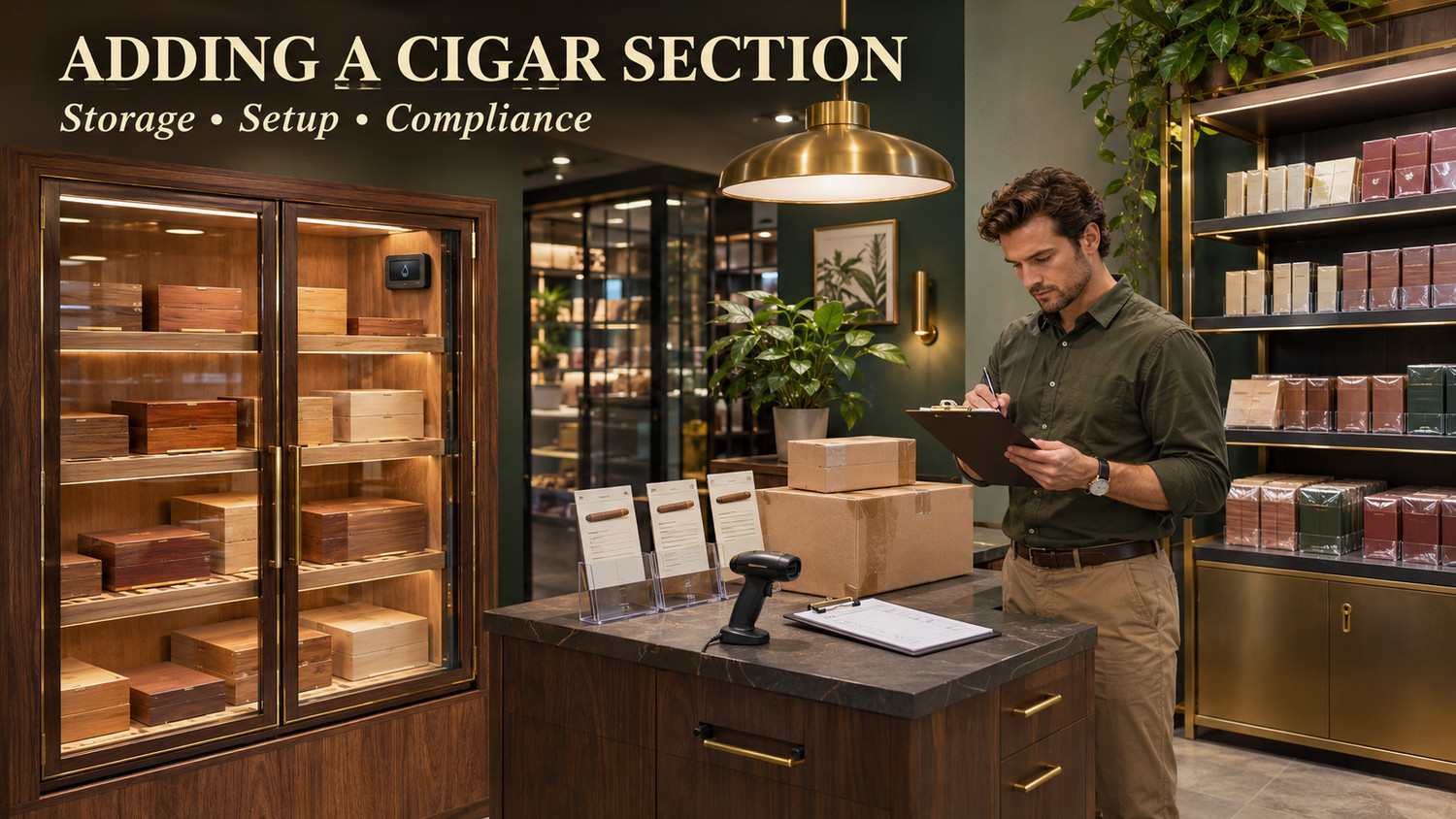
Avoid assuming that an attractive wooden cabinet automatically provides suitable storage.
A decorative display is not necessarily an appropriate controlled-storage environment for premium cigars.
Understand When Humidity Control Matters
Premium handmade cigars can be sensitive to prolonged exposure to unsuitable humidity and temperature.
A humidor or other controlled-storage unit may be appropriate for particular products, but the correct conditions depend on manufacturer guidance, product packaging, and the equipment being used.
Retailers should not apply one universal humidity setting to every cigar, cigarillo, and sealed tobacco package.
If humidity-control equipment is used, follow its installation, calibration, cleaning, and maintenance instructions.
Document any problems that could compromise merchandise, including malfunctioning equipment or moisture damage.
Appropriate storage helps preserve physical product condition. It does not reduce the health risks of tobacco use.
Evaluate Display Equipment for Storage and Security
Display equipment should be evaluated for its ability to protect merchandise and support accurate identification.
For products requiring humidity control, the equipment must maintain suitable conditions while allowing staff to inspect and access the contents.
A display that looks attractive but cannot maintain appropriate environmental conditions may expose merchandise to avoidable deterioration.
Sealed machine-made products and premium handmade cigars may have different storage requirements.
Any physical arrangement should also comply with applicable retail-access restrictions and security procedures.
Keep Product Identification Clear
A single cigar manufacturer may offer numerous product families and sizes.
Two packages sharing a recognizable brand name may still differ in series, dimensions, or quantity.
An inventory record should identify the manufacturer, complete product name, variation, packaging quantity, and SKU, when available.
For larger cigars, manufacturer-documented length and ring gauge provide additional identification.
For cigarillos, record both the number of cigars per retail pack and the number of packs within each display.
These details make it easier to compare physical merchandise against purchase orders and invoices.
Establish Receiving Procedures
Incoming shipments should be inspected before quantities are entered into inventory.
Compare the purchase order, supplier invoice, and physical shipment. Check for damaged cartons, broken seals, moisture exposure, and packaging discrepancies.
If a shipment contains a display of 15 retail packs, each containing four cigarillos, the record should distinguish 15 retail packages from 60 individual cigars.
Do not assume the term case represents the same quantity across different manufacturers.
World Vape USA's existing inventory planning guide explains general stock-counting and receiving concepts. Those principles may inform recordkeeping, although cigar-specific requirements must be considered separately.
Prepare Staff for Tobacco Age Verification
Federal law prohibits selling tobacco products to anyone younger than 21.
The FDA also requires retailers to check photographic identification for customers younger than 30 who attempt to purchase covered tobacco products, including cigars.
Federal rules prohibit free cigar samples and restrict tobacco vending-machine sales in locations where people younger than 21 are present or permitted to enter.
Stores should establish procedures for checking identification, refusing prohibited transactions, and handling tobacco-related compliance questions.
World Vape USA's retailer compliance checklist provides broader documentation context, but its vape-specific provisions should not automatically be applied to cigars.
Official FDA resources appear at the end of this article.
Confirm Packaging, Warning, and Local Rules
Cigar packaging and advertising requirements have been affected by federal litigation, including the 2020 decision vacating certain FDA cigar health-warning provisions.
Retailers should not rely on outdated descriptions of those vacated requirements.
Other applicable federal, state, and local obligations may still apply, including requirements concerning labeling, licensing, taxation, and retail sales.
Rules can also differ for manufacturer-packaged cigars and products sold individually.
A wholesale listing does not establish legal retail eligibility in every jurisdiction.
Current regulatory guidance and the appropriate government agencies should determine compliance decisions.
Document Business Account and Ordering Information
A wholesale account can provide purchase records and access to product information, but it does not replace local licensing or product-specific legal verification.
World Vape USA explains its business verification and ordering requirements on its How to Order page.
Its wholesale FAQ provides additional information about accounts, shipping, and general product availability.
Before any transaction, confirm the complete product description, current ordering terms, and documentation required for the destination.
Frequently Asked Questions
Can an existing vape shop add a cigar section?
Potentially, but the business must verify applicable licensing, local permissions, and product-specific requirements first.
Does a cigar section require a humidor?
Not every cigar format has identical storage needs. Follow the manufacturer's guidance for each product.
Can cigarillos and premium cigars use the same inventory category?
They should remain separately identifiable because construction, packaging quantities, and storage requirements can differ.
What information belongs on a cigar inventory record?
The manufacturer, complete product name, variation, package count, SKU when available, invoice details, and receiving condition.
Does a tobacco retail license cover every cigar product?
Not necessarily. Licensing conditions depend on the jurisdiction and the business's activities.
What is the federal minimum age for cigar purchases?
21 years old. Retailers must also follow federal identification-check requirements.
Can cigar products be displayed anywhere in a smoke shop?
Not necessarily. Display and access rules may depend on applicable federal, state, and local requirements.
Does a wholesale account establish that a cigar can legally be sold?
No. Product legality and retail permissions must be verified independently.
Your Cigar Section Readiness Checklist
Before introducing a cigar section, confirm that the store has addressed licensing, appropriate storage, product identification, shipment inspection, employee training, and applicable retail-sale requirements.
Keep manufacturer descriptions, invoices, and receiving records organized so quantities and discrepancies can be traced.
A documented process helps distinguish cigar-retail operations from the requirements of other smoke-shop product categories.
For information about World Vape USA's general wholesale procedures and business accounts, visit World Vape USA.
Official Resources
Health warning: Cigars contain addictive nicotine and pose serious health risks, including cancer and cardiovascular disease. Tobacco products are not safe for young people.