


Written by the World Vape USA Team · Updated October 25, 2026
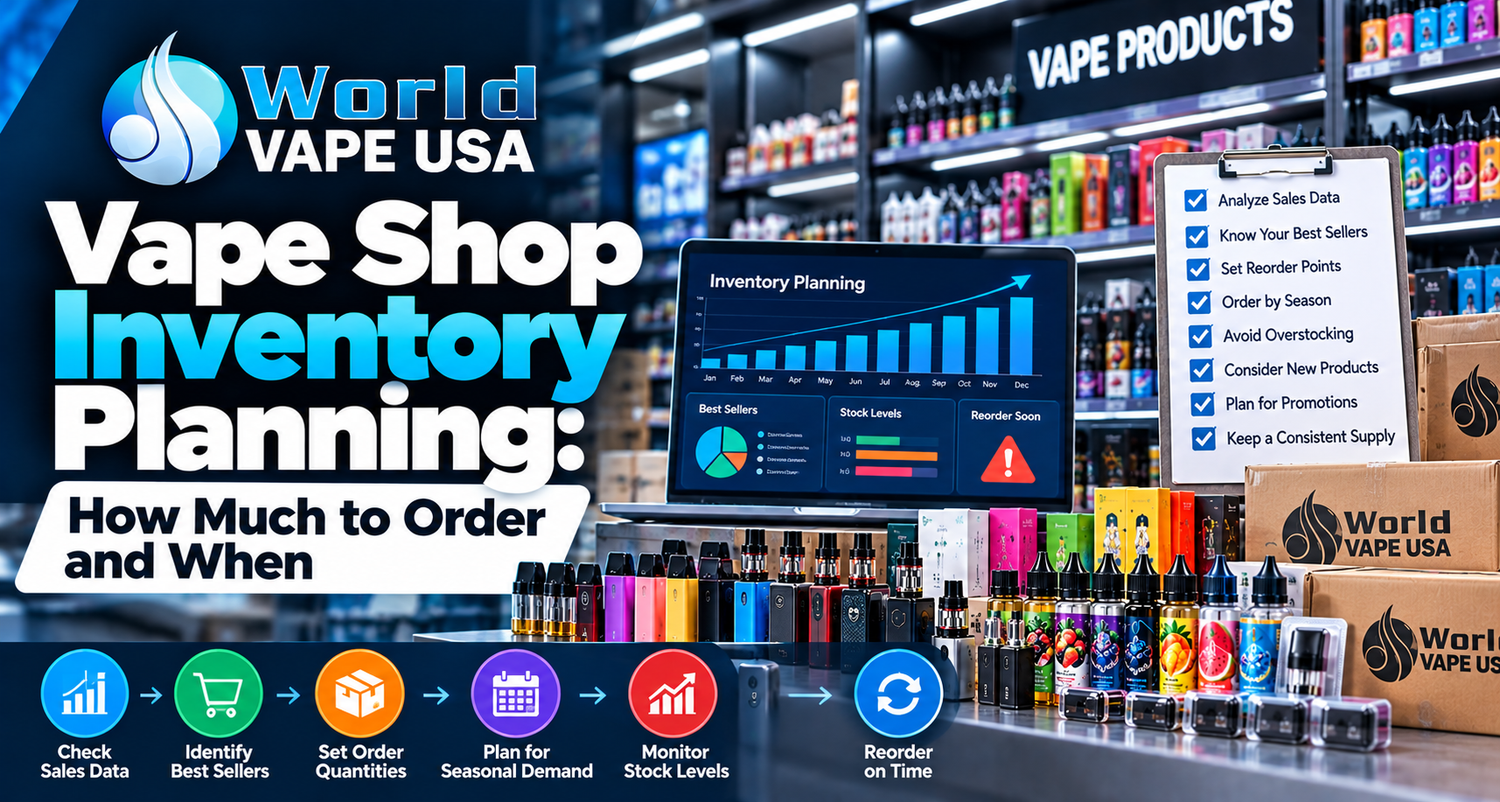
Quick answer: Plan vape shop inventory by tracking how fast each product sells, how long a reorder takes to arrive, and how much cushion you need in case a product is delayed or loses its legal status. A simple reorder point is average daily sales multiplied by supplier lead time in days, plus a safety stock. Sort products into A, B and C groups by how much revenue they bring in, count the A items most often, and avoid putting too much cash into any single product. Because the FDA and states keep changing which products can be sold, smaller and more frequent orders of confirmed products are usually safer than one large order. World Vape USA is a B2B vape wholesale distributor in Elmhurst, Illinois, and this guide gives smoke shops and vape shops a practical system they can start using this week.
Planning your next order? Browse the wholesale disposable vapes catalog by brand, then contact World Vape USA with your business and license details and ask which products can be supplied to your location. Retailers only, adults 21 and older.
Why inventory planning matters more in vape retail
Most retail categories can sit on a shelf for months without changing. Vape products are different in three ways that make planning more important.
- Legal status can change. The FDA and states keep changing which products can be sold. The FDA's May 8, 2026 bulletin, "Enforcement Priorities for Certain New Tobacco Products Marketed Without Premarket Authorization," describes how the agency will focus on the most deceptive and dangerous products, worst actors and egregious conduct. Law-firm summaries say that guidance is about enforcement priorities and is not legal permission to sell, so a product can stay a risk even when it is not the top priority.
- Demand follows trends. A device that sells quickly one month may slow down the next, and customers often ask for something new before you have it.
- Cash is tied up in stock. A shelf of slow products is money you cannot use to buy the products that are selling.
The goal of inventory planning is not to hold as much stock as possible. It is to hold enough of the right products, confirmed for your state, so you rarely run out of the items customers ask for and rarely get stuck with items that will not move.
Step 1: Know your numbers before you reorder
Everything else in this guide depends on three numbers for every product you carry. If you do not have them yet, spend a week collecting them. Most point-of-sale systems can report them, and a spreadsheet works if not.
- Average daily sales. Units sold over a period divided by the number of days. Use at least four weeks so a single busy weekend does not distort it.
- Lead time. The number of days between placing an order and having the product on your shelf. Measure your own history instead of relying on a promise. Check order dates and delivery dates on past invoices.
- Unit cost and selling price. From these you get gross margin per unit, which tells you which products deserve the most attention.
Write these in one place, one row per product. The template later in this guide gives you a layout.
Step 2: Calculate a reorder point
A reorder point is the stock level at which you place a new order. The basic formula is:
Reorder point = (average daily sales × lead time in days) + safety stock
The first part covers what you expect to sell while you wait for the order to arrive. Safety stock is the cushion that covers surprises, such as a delayed shipment or a sudden rush of demand.
Worked example (hypothetical numbers)
These numbers are invented to show the arithmetic. They are not a forecast, a benchmark or a recommendation for any product.
| Item | Value |
|---|---|
| Average daily sales | 4 units |
| Lead time | 7 days |
| Expected demand during lead time | 4 × 7 = 28 units |
| Safety stock (your choice) | 10 units |
| Reorder point | 28 + 10 = 38 units |
In this example you place a new order when the shelf and back room together reach 38 units. If the supplier ships faster than expected, you end up with a little extra. If it ships slower, the safety stock covers the gap.
How to set safety stock
There is no universal number, because it depends on how steady your sales are and how reliable your supplier's delivery is. Use these questions:
- How much does weekly demand for this product swing up and down? More swing needs more safety stock.
- How often has a delivery been late? If it happens often, raise the cushion.
- How bad is running out? For a top seller that brings customers in, a stockout is costly, so the cushion should be larger.
- How risky is the product? If its legal status could change, a large cushion is a risk in itself, so keep it small.
Step 3: Sort products into A, B and C groups
You cannot give every product the same attention. ABC grouping is a simple way to decide where your time goes.
- List every product with its sales for the last 90 days.
- Multiply units sold by selling price to get revenue per product. For a profit view, use gross margin instead.
- Sort from highest to lowest.
- Mark the top group that makes up most of your revenue as A, the middle group as B, and the long tail as C. The exact cut-offs are your call. Many shops use roughly the top fifth of products as A, but test what fits your store.
| Group | What it is | How to manage it |
|---|---|---|
| A | Your best sellers by revenue or margin | Count most often, set firm reorder points, keep a safety stock, review weekly |
| B | Steady middle products | Review every two to four weeks, modest safety stock |
| C | Slow or occasional sellers | Order small quantities only when needed, consider removing items that do not move |
Review the groups every quarter. A product can move from A to C quickly, and a new product can climb fast.
Step 4: Track sell-through, not just stock
Sell-through tells you how much of what you bought actually sold. It is a better health check than stock count alone.
Sell-through rate = units sold ÷ units received, over a set period.
For example (hypothetical), if you receive 50 units of a product and sell 40 of them in a month, sell-through is 80 percent for that month. A product that sells through quickly is a candidate for a larger or more frequent order. A product that sells through slowly should get a smaller order, a display change or a price review.
Also track days of supply: current stock divided by average daily sales. If you hold 120 units and sell 4 a day, you have 30 days of supply. Compare that number to your lead time and your cash position. A very long supply of one product means cash is parked on your shelf.
Step 5: Keep cash flow in the plan
Inventory is a use of cash. Before you place any order, ask three questions.
- How much of my budget is this? Decide a total spending limit per period, then divide it across categories.
- How many days of supply does it add? Aim to cover your lead time plus a cushion, not several months.
- What happens if this product cannot be sold? If a product's status changes, can you absorb the loss? If not, order less.
Many shops find that two or three smaller orders a month are safer than one large one. You pay shipping more often, but you reduce the amount of cash exposed to a single product or a single change in rules.
Step 6: Build a regulatory risk buffer
This is the part of vape inventory planning that most other retail guides do not cover.
The FDA's May 8, 2026 bulletin and the law-firm summaries of it make three points that matter to a buyer. First, any new tobacco product without authorization is still illegally marketed. Second, the guidance is about enforcement priorities and is not legal permission to sell. Third, the FDA can still act against any product, and its approach can change. Twenty-one state attorneys general also wrote to the FDA on May 11, 2026 objecting to the guidance, according to a law-firm summary.
State rules add another layer. Kentucky, for example, limits sales to authorized vapor products under HB 11, according to the Kentucky Department of Alcoholic Beverage Control. Other states use product directories, flavor restrictions or licensing rules. Our guides to Kentucky vape wholesale rules and California vape wholesale rules show how different two strict states can be.
Practical ways to build a buffer into your inventory:
- Confirm status before you buy. Get written product status from the supplier and check it against the FDA's current lists and your state's rules. Our supplier checklist lists the questions to ask.
- Cap exposure per product. Set a maximum share of your inventory budget that any one product, brand or status category can take.
- Keep days of supply short for higher-risk items. If you cannot confirm a product's status, hold a small quantity or none.
- Diversify categories. A shelf that includes e-liquid, vaporizers, nicotine pouches and hookah products depends less on any one product's status. Confirm each category's rules separately.
- Watch for changes. Review FDA announcements and your state agency's notices on a schedule, such as the first of each month.
Step 7: Avoid overstocking any single product
It is tempting to buy large quantities of a hot product because the per-unit cost may look better. Weigh that against the risks of overstock.
| Risk | Why it matters |
|---|---|
| Status change | A product can lose its ability to be sold in your state, and stock on hand becomes a loss. |
| Trend shift | Customers move to a new device or format, and your stock slows down. |
| Cash tied up | Money sitting on a shelf cannot buy fast-moving items. |
| Storage and handling | Large quantities need space, and products should be kept as the manufacturer directs. |
| Theft exposure | More units out increases the chance of loss. |
A useful rule is to set a maximum days-of-supply for each group, for example a short limit for C items and a longer, but still capped, limit for A items you have confirmed. Pick limits that match your cash position and your lead time.
If you want to compare brands and formats before deciding what to stock, our guide to wholesale disposable vapes explains how to read a listing, and the brand pages for Geek Bar, Lost Mary, Raz, Mr Fog and North show the formats we list. Listing a product does not mean it can lawfully be sold in your state, so treat the legal check as a separate step.
Step 8: Set up counting cycles
Counting everything once a year is slow and hides problems for months. Cycle counting means counting a small group of products on a regular schedule.
- A items: count weekly or at each reorder decision.
- B items: count every two to four weeks.
- C items: count monthly or quarterly.
- Full count: do a complete count at a set point each quarter or as your accountant advises.
Whenever a count does not match your records, write down the product, the difference and your best explanation. A pattern of differences on one product is a clue that something is wrong, such as mislabeled stock, receiving errors or theft.
Step 9: Receive orders carefully
Inventory errors often start at the door. Make receiving a routine.
- Compare the packing slip to your purchase order and to what is physically in the box.
- Check for damage and note it before the carrier leaves when possible.
- Check that the packaging and labeling look like the product you ordered. Counterfeit and misdeclared products are a stated FDA enforcement priority.
- Record the delivery date so you can update your real lead time.
- Photograph any problem and contact your supplier promptly, in writing.
- Update your inventory records the same day.
For how orders work at our end, see how wholesale ordering works at World Vape USA.
Step 10: Control shrink and theft
Shrink is inventory that disappears from error, damage or theft. Vape products are small and valuable, so they deserve extra attention. Practical controls include:
- Keep the highest-value and most-stolen items behind the counter or in locked cases.
- Limit who has keys to the back room, and keep a record of who opens it.
- Place cameras where they cover the counter, displays and storage.
- Count high-risk items at opening and closing.
- Train staff to verify age and ID on every sale. Federal and state rules limit sales to adults, and the FDA's retailer materials describe sales to adults 21 and older, according to a law-firm summary. Check your state's rules too.
- Investigate count differences quickly, while memories and camera footage are fresh.
Step 11: Keep records that protect you
Good records help your business and also give you a defense if a regulator asks questions. Keep these together, organized by supplier and date:
- Itemized invoices and packing slips.
- Written product-status answers from your supplier.
- Copies of your licenses and permits.
- Any state certificates or documents your state requires for the products you sell. In Kentucky, for example, the ABC FAQ says retailers must keep safe harbor certificates for products not on the FDA's authorized list, unless bought from a Kentucky-licensed resident wholesaler.
- Records of adult-signature deliveries and age checks as your rules require.
- Your counts, adjustments and notes on differences.
Ask your accountant or attorney how long to keep each type of record. Do not delete records because a product has been removed from your shelves.
Step 12: Store and handle products properly
Follow each manufacturer's storage and handling instructions printed on the packaging or provided by the supplier. Do not guess. As a general business practice, keep stock organized so older units are sold first, keep stock off the floor and away from damage, and keep the back room secure. If a product has a storage warning, follow it.
Step 13: Score your suppliers
Inventory planning depends on the supplier doing what it says. Track a few facts about each supplier every month.
| Measure | What to record |
|---|---|
| Actual lead time | Order date to delivery date, per order |
| Order accuracy | Units or items that did not match the order |
| Damage and returns | How many units arrived damaged, and how the supplier handled it |
| Status transparency | Whether the supplier gave written product status when asked |
| Communication | How fast and how clearly questions were answered |
| Price stability | Whether pricing changed between quotes and invoices |
Many retailers keep one primary distributor for the core range and a second vetted source for backup, so a delay or product removal does not leave the shelf empty.
Printable inventory template
Copy this table into a spreadsheet and add one row per product. The sample row is hypothetical.
| Product | Group (A/B/C) | Status confirmed (date, source) | On hand | Avg daily sales | Lead time (days) | Safety stock | Reorder point | Days of supply | Last count |
|---|---|---|---|---|---|---|---|---|---|
| Example product | A | Written status on file | 60 | 4 | 7 | 10 | 38 | 15 | Weekly |
A weekly routine you can run in 30 minutes
- Monday: pull last week's sales and update average daily sales for A items.
- Tuesday: compare on-hand counts to reorder points and list items to order.
- Wednesday: check each item on the order list for confirmed status in your state, then place the order.
- Thursday: receive and check any deliveries, then update records and lead times.
- Friday: do a quick count of one group, note differences and review slow movers.
- First of the month: review FDA and state updates, supplier scores and the A/B/C groups.
How World Vape USA supports retailers who plan their inventory
World Vape USA is a B2B wholesale distributor based in Elmhurst, Illinois. Retailers create a business account, browse the catalog by brand and order online, with wholesale pricing shown after login. We accept Visa, Mastercard, American Express and Discover. Customer service is available Monday through Friday, 10 am to 5 pm. Learn more about World Vape USA, and read the vape industry trends guide to see why status and enforcement matter to what you order. Because rules differ by state, we cannot supply every product to every location, so please ask before you place a large order.
Quick facts
| Topic | Vape shop inventory planning |
| Core formula | Reorder point = (average daily sales × lead time) + safety stock |
| Key groups | A, B and C products by revenue or margin |
| Key risk | Product status and state rules can change |
| Business | World Vape USA (World Wholesale), B2B wholesale distributor |
| Customers | Smoke shops, vape shops and other retailers, adults 21 and older |
| Location | 845 N. Larch Ave, Suite 3, Elmhurst, IL 60126 |
| Phone | (331) 979-7113 |
| Customer service hours | Monday through Friday, 10 am to 5 pm |
Glossary
- Reorder point: The stock level at which a new order is placed.
- Lead time: The days between placing an order and receiving it.
- Safety stock: Extra inventory held to cover delays or surprise demand.
- ABC analysis: A method of sorting products into groups by their importance to revenue or margin.
- Sell-through rate: Units sold divided by units received over a period.
- Days of supply: Current stock divided by average daily sales.
- Shrink: Inventory lost to error, damage or theft.
- Cycle counting: Counting a small group of products on a regular schedule.
- Authorized vapor product: In some states, a product with FDA authorization or another status the state requires; rules differ by state.
- SKU: A stock-keeping unit, the unique code for one product and size or flavor.
Frequently asked questions
How much vape inventory should a small shop keep?
There is no single number. Base it on your average daily sales, your supplier's lead time and your cash. A common approach is to cover lead time plus a modest safety stock for each product, and to cap how many days of supply any one product can take.
What is a reorder point?
It is the stock level at which you place a new order. A basic formula is average daily sales multiplied by lead time in days, plus safety stock.
How do I calculate lead time?
Use your own order history. Subtract the order date from the delivery date for several past orders and use the average, plus a note of the longest delay you have seen.
What is safety stock?
Safety stock is extra inventory you hold to cover delays or unexpected demand. Set it higher for steady best sellers and lower for products with an uncertain legal status.
What is ABC inventory analysis?
It sorts products into A, B and C groups by how much revenue or margin they bring in. A items get the most attention, counts and safety stock, and C items get the least.
How often should I count inventory?
Count your best sellers weekly or at each reorder decision, middle products every two to four weeks and slow products monthly or quarterly. Do a full count on a set schedule, as your accountant advises.
Should I buy in bulk to lower my cost per unit?
Only if you can sell it before demand, rules or cash needs change. A lower cost per unit does not help if the product cannot be sold in your state or sits on the shelf. Smaller, more frequent orders of confirmed products are often safer.
How can a change in FDA or state rules affect my inventory?
A product's status can change, and stock you cannot lawfully sell becomes a loss. The FDA's May 8, 2026 bulletin describes enforcement priorities, and law-firm summaries say it is not legal permission to sell. Keep days of supply short for products whose status you cannot confirm.
What records should I keep for inspections?
Keep itemized invoices, packing slips, written product-status answers from suppliers, copies of licenses and any certificates your state requires. Ask an accountant or attorney how long to keep each type.
How do I reduce theft and shrink?
Keep valuable items behind the counter or in locked cases, limit key access, use cameras, count high-risk items at opening and closing, and investigate count differences quickly.
How many suppliers should I use?
Many retailers use one primary distributor for their core range and a second vetted supplier as backup, so a delay or a product removal does not empty the shelf.
Can World Vape USA help me plan what to order?
We can answer questions about the catalog and which products can be supplied to your location. Contact us with your business and license details. Inventory decisions and legal compliance remain the retailer's responsibility.
Next step
Questions about what World Vape USA can supply to your location? Contact us with your business and license details, review the wholesale disposable vapes catalog, or start at the vape wholesale distributor homepage. More guides are on our retailer blog.
Sources
- FDA bulletin, May 8, 2026: Enforcement Priorities for Certain New Tobacco Products Marketed Without Premarket Authorization
- Regulatory Oversight: FDA guidance on enforcement discretion for certain ENDS and nicotine pouch products (May 2026)
- Buchanan Ingersoll & Rooney, October 1, 2025: Increased Enforcement and Seizure Activity of Nicotine Vaping Products
- Kentucky Department of Alcoholic Beverage Control: HB 11 FAQ
This guide is for general information and is not legal advice. Laws, FDA actions and enforcement change often, so confirm current requirements with the FDA, your state agency or an attorney before you buy or sell.